What to Look for When Choosing an Oregano Oil Supplier for B2B Manufacturing
When sourcing oregano oil for food, pharmaceutical, or cosmetic manufacturing, the most reliable supplier is one that owns its extraction and testing infrastructure, provides batch-specific gas chromatography analysis with every shipment, holds certifications relevant to your end application, and accommodates flexible order volumes.

How to Choose an Oregano Oil Supplier for B2B
When sourcing oregano oil for manufacturing, buyers can assess supplier control, batch-specific testing, relevant certifications, documentation, and suitable order volumes. These controls may reduce procurement risk, but they do not guarantee identical future batches. Acceptance criteria depend on the intended use, jurisdiction, and buyer specification.
In this guide, “supplier” means the company selling the oil; it may also be the manufacturer or may source from a contract distiller, which processes oil for another company. An independent laboratory tests samples but does not certify the product. A certification body verifies conformity to a specific scheme, while an accreditation body assesses a laboratory’s competence within a defined scope.
Evaluating Wholesale Oregano Oil Suppliers and Bulk Specifications
Vertical integration may improve visibility and control, but it does not by itself prove consistency. Buyers should verify its actual value through batch records, validated specifications, testing, and change-control documentation. Suppliers using contract distillers or other sourcing models can also meet requirements if responsibilities and controls are clear.
Oregano oil composition varies with plant genetics, growing conditions, harvest timing, and processing. Carvacrol and thymol are commonly relevant to product specifications, but their acceptable ranges depend on the application. Ask how the supplier identifies the source and production lot, manages changes to raw materials or processes, and handles out-of-specification results.
A supplier’s response to a documentation request can help you assess its systems. Ask for a batch-specific certificate of analysis (COA), Safety Data Sheet (SDS), specification, and traceability information. If documents are unavailable, treat that as a reason for further qualification rather than proof of poor quality control.
Testing and Certificate of Analysis
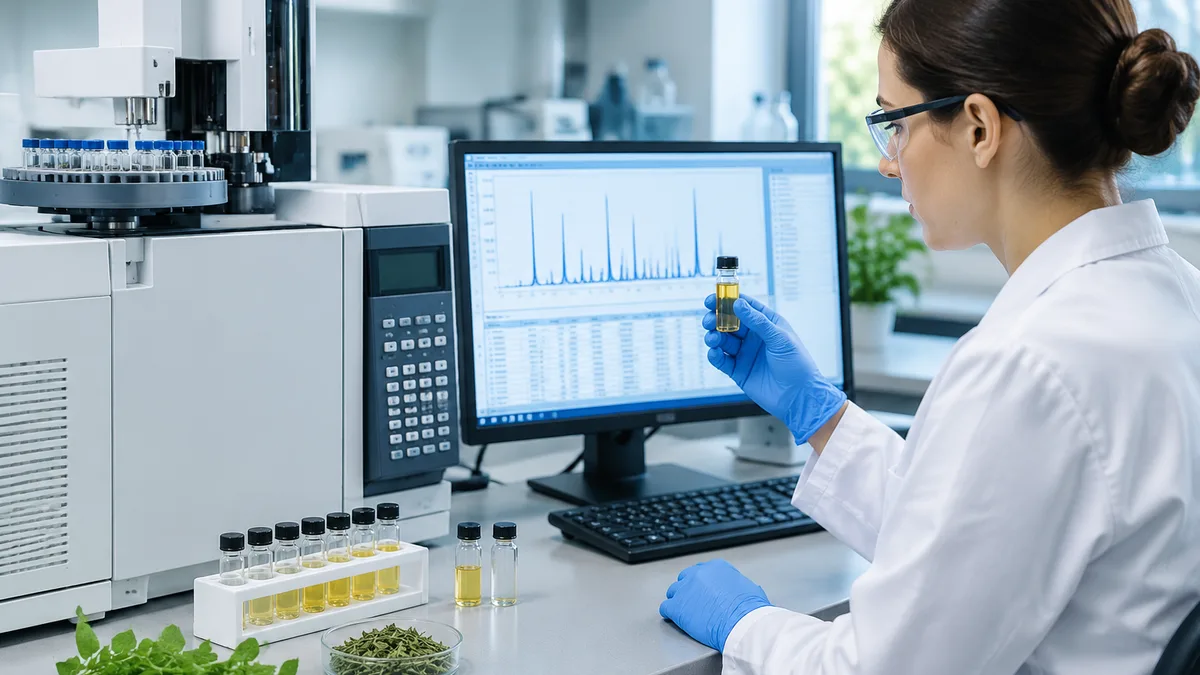
GC-MS and GC-FID are commonly used tools for essential-oil analysis, but the appropriate method and reporting requirements depend on the specification and application. Screening can flag unexpected results; identification assigns likely identities to detected compounds; quantification estimates their amounts; and confirmation may require additional testing or reference standards.
GC-MS can provide information about compounds based on their mass spectra, while GC-FID is commonly used to measure relative or calibrated quantities. Neither a chromatogram nor a method name alone establishes product suitability. Ask whether sample preparation, method validation, reference standards, and laboratory scope are appropriate for the intended analysis.
What to Check on a Certificate of Analysis
Review the COA against the approved specification and confirm:
• Product name, batch or lot number, sample date, test date, and laboratory identity.
• Test method, reporting units, analytes, results, and acceptance criteria.
• Whether results are batch-specific or represent a typical profile.
• Any relevant limits, measurement uncertainty, and sample details.
A buyer may specify analytes such as carvacrol, thymol, para-cymene, gamma-terpinene, and linalool, but this is not a universal minimum list. Likewise, batch testing with every shipment may be appropriate for some risk profiles and unnecessary for others. Set frequency and required documents in the purchase specification.
ISO/IEC 17025 accreditation indicates that an accreditation body has assessed a laboratory against specified competence requirements within a defined scope. Verify the laboratory’s current accreditation status and scope, including method and matrix. Accreditation is not a guarantee that every result is correct. For guidance, consult the ILAC directory of signatories.
Compare results with your approved specification, the method’s uncertainty, your sampling plan, and historical variability. Differences may warrant investigation, but there is no universal percentage threshold. Request chromatograms or results from multiple lots when needed to evaluate variation and suitability.
Certification, Accreditation, and Application Requirements
Certification, accreditation, and management systems are distinct. A certification body verifies a product, process, or management system against a defined scheme. An accreditation body assesses the competence of a conformity-assessment body, such as a laboratory. HACCP and GMP describe systems or practices; their status and legal effect depend on the applicable scheme and jurisdiction.
Certification by End Use
The table is a starting point, not legal advice. Requirements depend on product category, claims, manufacturing role, and destination market. Confirm obligations with regulatory counsel and the relevant regulator or certifier.
| Application and jurisdiction | Legally required | Commonly requested | Optional verification |
|---|---|---|---|
| Food, United States | Applicable FDA food-safety and labeling rules; requirements vary by product and use | Supplier hazard-control records and product specifications | Organic, Kosher, or Halal certification where relevant to claims or buyers |
| Food, European Union | Applicable EU food, hygiene, and labeling rules; confirm ingredient status and intended use | Traceability records and risk-based testing | Organic certification under applicable EU rules; religious certification where relevant |
| Dietary supplements, United States | Applicable FDA dietary supplement rules, depending on product and activity | GMP-related records and identity/specification controls | Independent certification or additional testing |
| Cosmetics, United States or European Union | Applicable jurisdictional cosmetic safety, labeling, and manufacturing obligations | SDS, specifications, and supporting safety information | Organic, Kosher, or Halal certification when relevant to claims or buyers |
| Pharmaceutical or infant-food use | Product-specific rules and authorization requirements vary substantially by jurisdiction | Application-specific supplier qualification and quality documentation | Additional audits or testing defined by the buyer |
For U.S. organic claims, consult the USDA National Organic Program and confirm product and handler coverage with the certifier. For U.S. food requirements, refer to FDA food safety guidance. EU buyers can review EU food hygiene rules and organic production rules. These sources do not determine whether oregano oil is suitable for a particular formulation.
Kosher and Halal requirements vary by buyer, product, and certifying body. Confirm the certificate’s scope, product listing, validity, and the issuing body’s verification process directly. For any certification, check the covered site and product rather than assuming a facility-level certificate applies to every item.
Supplier Qualification and Procurement Checklist
Use a documented process: define the application and destination market; establish specifications and acceptance criteria; review supplier records and certificates; evaluate samples or batches according to risk; resolve gaps; then approve the supplier and set change-notification and review requirements. Keep supplier qualification records, including the decision, responsible reviewers, approved documents, and any conditions of approval.
Questions to Ask Before Ordering Bulk Oil
| Area | Questions for the supplier |
|---|---|
| Product and quality | What are the specification, origin, production method, batch coding, and out-of-specification process? Which tests and records are available? |
| Documentation | Can you provide a batch COA, SDS, specification, traceability records, and applicable certificates? How are document revisions controlled? |
| Testing | Which laboratory performs each test? What are the validated scope, method, reporting units, acceptance criteria, and uncertainty? |
| Change control and recall | How will changes to source, process, site, or specification be communicated? What are the notification, traceability, and recall-support procedures? |
| Commercial terms | What are the minimum order quantity (MOQ), price basis, volume breaks, payment terms, and quotation validity? |
| Logistics | What packaging formats and sizes are available? What are lead times, transport conditions, Incoterms, and shipping responsibilities? |
| Storage and shelf life | What storage conditions, packaging protections, and shelf-life period apply? How is remaining shelf life handled at delivery? |
| Compliance | Which requirements apply to the product’s intended use and destination? Which records or certifications support the buyer’s claims? |
For a supplier comparison, score each candidate against buyer-defined criteria, such as specification fit, documentation, testing capability, traceability, regulatory support, lead time, MOQ, packaging, and total landed cost. Weight criteria by risk and intended use; do not treat one sourcing model or certificate as a substitute for evidence.
Sample Evaluation and Ongoing Review
Before a large commitment, request representative samples or batch records according to your qualification plan. Where independent testing is justified, agree on sampling, methods, acceptance criteria, and how discrepancies will be resolved before testing begins. Compare laboratory results with supplier COAs and investigate differences in light of method uncertainty and sample handling.
An independent sample test can provide useful evidence about the tested material, but it does not alone predict formulation stability or future-lot performance. Reassess supplier performance using complaint history, delivery records, change notifications, and results against the approved specification. Testing frequency should reflect the product’s risk, applicable rules, and the buyer’s quality system.
A supplier that provides clear records, defined responsibilities, and timely change and recall support may be easier to qualify and manage. Evaluate those factors alongside product fit, commercial terms, and your regulatory obligations before approving a wholesale oregano oil source.
References
HBNO. Oregano Oil Sourcing: Carvacrol Levels & GC/MS Specs – HBNO.
WikiAromatics. Essential Oil Quality Control: GC-MS and ISO Standards | WikiAromatics.
Arovella. How to Read a GC-MS Report: Essential Oil Buyer Guide.
Frequently Asked Questions
Practical answers related to this article.
What key documents should I request from a bulk oregano oil supplier?
Request a batch-specific certificate of analysis (COA), Safety Data Sheet (SDS), specification, and traceability information.
What is the difference between a certification body and an accreditation body?
A certification body verifies conformity to a specific scheme, while an accreditation body assesses a laboratory’s competence within a defined scope.
Why is a batch-specific certificate of analysis (COA) important?
A batch-specific COA verifies that the tested batch meets the approved specification, including product name, batch number, test methods, analytes, results, and acceptance criteria.
What are the common analytical methods for testing oregano oil?
GC-MS and GC-FID are commonly used tools for essential-oil analysis.
How should I evaluate a supplier's laboratory testing capabilities?
Verify the laboratory's current ISO/IEC 17025 accreditation status and scope, including method and matrix, and ask about sample preparation, method validation, reference standards, and laboratory scope.
What questions should I ask a supplier before ordering bulk oregano oil?
Ask about product specification, origin, production method, batch coding, out-of-specification process, available tests and records, change control, recall procedures, commercial terms, logistics, storage, shelf life, and compliance.