How a Personal Care Brand Validated Quality with Free Samples Before Committing to Bulk Orders
A personal care brand validates essential oil quality through free samples and batch documentation before committing to bulk orders, reducing costs by 15% without compromising product consistency.
The Supplier Dilemma: Balancing Cost and Consistency
A mid-sized personal care brand manufacturing natural body lotions and facial serums faced a common procurement challenge: their existing essential oil supplier delivered acceptable quality, but pricing had increased steadily over three years, and batch-to-batch variability forced minor formulation adjustments that consumed R&D resources. The brand's procurement team identified several alternative suppliers offering 12–18% lower unit costs, yet the product development director resisted any change. Her concern was grounded in operational reality: switching suppliers without rigorous validation could introduce subtle differences in odor profile, color, or chemical composition that would alter the sensory experience customers had come to expect. A single failed batch could trigger customer complaints, product recalls, and lasting damage to brand reputation.
The brand had built its market position on transparency and ingredient integrity, prominently listing essential oils on every label and marketing the therapeutic benefits of lavender, tea tree, and eucalyptus in its hero products. Any supplier transition required more than a favorable quote; it demanded verifiable proof that the new source could match or exceed current quality across multiple production runs. The procurement team needed a structured validation pathway that minimized financial exposure while generating enough data to make an informed decision. Without access to representative samples and batch-specific analytical documentation, the risk of switching remained unacceptably high, leaving the brand locked into an increasingly expensive supply relationship.
The Hidden Costs of Supplier Switching Without Validation
Changing a natural essential oil supplier introduces several layers of technical and commercial risk that extend far beyond the purchase price. Essential oils are chemically complex mixtures of dozens to hundreds of volatile compounds, and even oils meeting the same botanical specification can differ significantly in their constituent profiles depending on harvest season, geographic origin, distillation parameters, and post-extraction handling. A lavender oil that passes basic identity tests may still exhibit a sharper camphor note or a different linalool-to-linalyl acetate ratio than the oil a brand has been using for years. For a personal care formulation, these differences can shift the final product's scent character, alter its stability in emulsion, or affect the claimed aromatherapeutic properties.
The financial consequences of an unvalidated switch extend beyond the immediate material cost. If a new supplier's oil performs poorly in production, the brand may need to reformulate mid-run, adjust preservative systems, or discard finished goods that fail sensory panels. Customer-facing risks are even more serious: a subtle change in fragrance can prompt negative reviews, reduce repeat purchase rates, and erode the trust that took years to build. Regulatory documentation also becomes a burden; any supplier change requires updating technical dossiers, safety assessments, and allergen declarations, work that must be repeated if the new supplier proves unsuitable and the brand reverts to the original source.
Batch-to-batch consistency presents an additional layer of uncertainty. Natural products vary by crop season, geographic origin, and processing conditions, and a supplier's first sample may not reflect the quality delivered in subsequent orders. Without access to multiple batches and the corresponding analytical certificates, a buyer cannot assess whether a supplier maintains tight process controls or simply got lucky with a single lot. Suppliers sourcing oils through intermediaries face inherent variability because they do not control the extraction and testing steps; those operating their own facilities and quality laboratories can enforce tighter specifications and trace every batch to a known origin. The brand's procurement team understood these risks but lacked a low-cost mechanism to gather the evidence needed for a confident decision.
Fresure's Free Sample Program: Structured Validation with Batch Documentation
Fresure's sample program was designed specifically to address the validation gap that prevents brands from exploring alternative suppliers. The program allows qualifying B2B partners to request up to 10 essential oil samples at no charge, with each sample drawn from current production batches and accompanied by the same analytical documentation provided with commercial orders. Every sample ships with a batch-specific gas chromatography-mass spectrometry report that lists the concentration of major constituents, confirms botanical identity, and verifies the absence of adulterants or synthetic extenders. These reports are generated in Fresure's ISO-certified quality laboratory using the same instruments and methods applied to full-scale shipments, ensuring that sample data accurately predicts bulk-order performance.
The program serves a dual function: it gives buyers the material and data they need to conduct internal testing, and it demonstrates the supplier's confidence in process consistency. A supplier willing to provide multiple oils with full analytical transparency signals that batch variability is under control and that the quality observed in samples will carry through to production orders. For the personal care brand, this meant they could evaluate not only the sensory and functional properties of each oil but also the supplier's commitment to documentation and traceability, factors that directly affect regulatory compliance and audit readiness.
Qualifying for the sample program requires a brief intake conversation in which the supplier's technical team confirms the buyer's intended application, current volume requirements, and quality expectations. This step filters out casual inquiries and ensures that samples go to serious buyers who will conduct meaningful testing. Once approved, the buyer selects up to 10 oils from Fresure's catalog of 126+ products, specifying any particular grades or extraction methods relevant to their formulations. Samples typically ship within 48 hours and arrive with detailed product specification sheets, safety data sheets, and contact information for the technical support team, who remain available throughout the testing period to answer questions about analytical methods, storage recommendations, or formulation compatibility.
Laboratory Testing: Comparing New Samples Against Established Baselines
The personal care brand's product development team designed a three-phase testing protocol to evaluate the Fresure samples against their current supplier's oils. Phase one focused on sensory assessment: trained panelists compared the aroma intensity, top-note character, and dry-down profile of lavender, tea tree, eucalyptus, peppermint, rosemary, sweet orange, lemon, geranium, cedarwood, and frankincense oils side by side with reference standards from the incumbent supplier. Each oil was evaluated neat and in a standardized base formulation at the concentration used in the brand's commercial products. Panelists scored each sample on a structured scale and provided open-ended comments on any perceived differences.
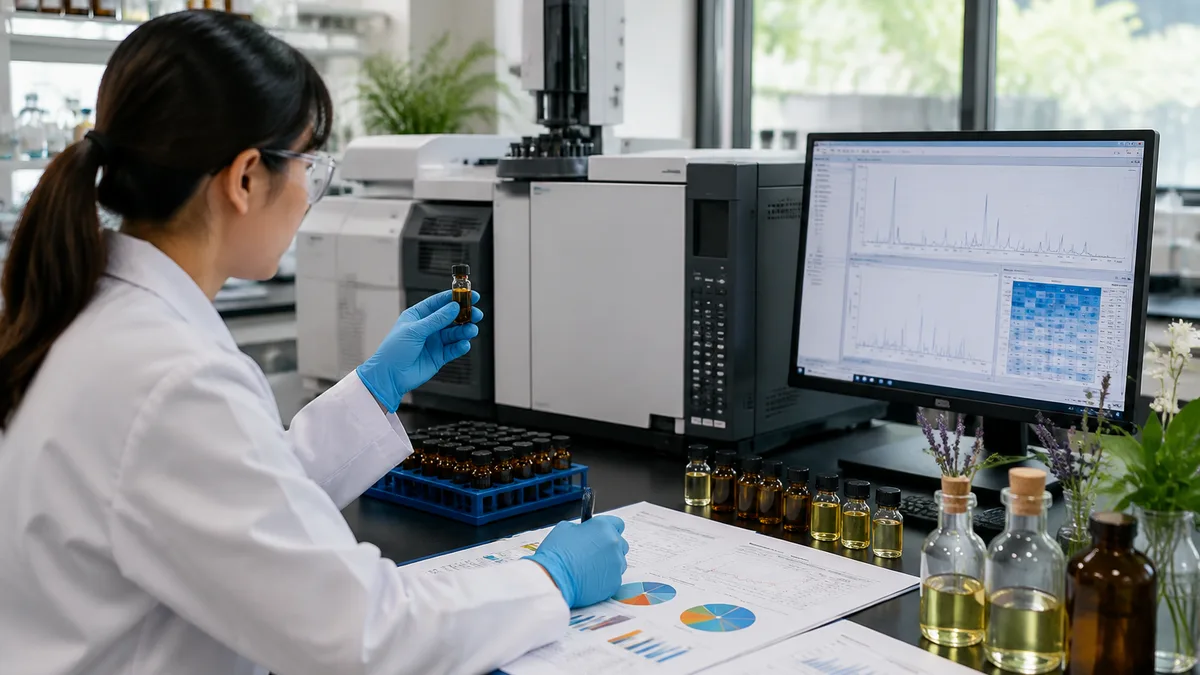
Phase two involved laboratory analysis. The brand's in-house analytical chemist reviewed the GC-MS reports provided by Fresure, comparing the reported constituent profiles against historical data from the current supplier and published monographs in the International Organization for Standardization and European Pharmacopoeia. For lavender oil, the chemist verified that linalool content fell within the 25–38% range typical of high-quality Lavandula angustifolia and that camphor remained below 0.5%, a marker that distinguishes true lavender from cheaper lavandin blends. Tea tree oil was checked for terpinen-4-ol content above 30% and 1,8-cineole below 15%, the thresholds specified in the ISO 4730 standard. Eucalyptus oil was confirmed to contain at least 70% 1,8-cineole, consistent with Eucalyptus globulus.
Phase three tested functional performance in finished formulations. The product development team prepared small batches of the brand's best-selling body lotion and facial serum using the Fresure samples, then subjected them to accelerated stability testing at elevated temperature and humidity. They monitored emulsion stability, color shift, and fragrance retention over a simulated three-month period, comparing results against control batches made with the incumbent supplier's oils. Microbial challenge tests confirmed that the new oils did not interfere with the existing preservative system, a critical checkpoint because some essential oils can reduce preservative efficacy or, conversely, contribute antimicrobial activity that must be accounted for in the formulation safety assessment.
The brand also requested a second round of samples for three oils—lavender, tea tree, and eucalyptus—drawn from different production batches to assess consistency. This step addressed the core concern that a single impressive sample might not reflect typical performance. The second set of samples arrived with new batch numbers and updated GC-MS reports showing constituent profiles within two percentage points of the initial samples, evidence that Fresure's vertically integrated production model delivered the tight process control the brand required. The chemist's report concluded that the Fresure oils met or exceeded the quality benchmarks set by the incumbent supplier, with lower batch-to-batch variability and more comprehensive documentation.
Validated Outcomes: Cost Reduction Without Quality Compromise
After completing the three-phase validation, the brand's procurement and product development teams jointly recommended moving forward with a bulk order. The initial purchase covered a six-month supply of the 10 tested oils, totaling approximately 850 kilograms across all SKUs. The delivered oils matched the sample quality in every measurable dimension: sensory panels could not distinguish finished products made with the new oils from those made with the previous supplier's materials, and accelerated stability data remained within specification. Customer feedback on the reformulated products was indistinguishable from historical norms, confirming that the supplier transition had introduced no perceptible change to the consumer experience.
The financial impact was immediate and substantial. Unit prices for the 10 oils averaged 15% lower than the incumbent supplier's most recent quote, translating to an annual raw material saving of approximately $48,000 at the brand's current production volumes. Because Fresure operates its own extraction facilities and ships directly to buyers without intermediary markups, the brand captured the cost advantage without sacrificing service quality or documentation standards. Payment terms were comparable, and lead times were slightly shorter due to Fresure's in-stock inventory model for high-volume oils.
Beyond direct cost savings, the supplier transition delivered operational improvements that reduced hidden costs. The incumbent supplier had provided basic certificates of analysis listing only a few key constituents, requiring the brand's lab to conduct supplementary testing to meet regulatory documentation requirements. Fresure's batch-specific GC-MS reports eliminated this duplication, saving approximately 12 hours of lab time per quarter. The technical support team responded to formulation questions within 24 hours, and the account manager proactively flagged an upcoming harvest-related supply constraint for frankincense oil, giving the brand time to adjust production schedules rather than facing an unexpected shortage.
The brand's product development director, initially the most skeptical voice in the supplier evaluation, became an advocate for the structured validation approach. In a post-implementation review, she noted that the sample program had provided more rigorous data than any previous supplier transition and that the ability to test multiple batches before committing had been decisive in overcoming internal resistance. The procurement team has since adopted the sample-based validation model as standard practice for all critical raw materials, extending the methodology to carrier oils, botanical extracts, and specialty ingredients.
A Replicable Framework for De-Risking Supplier Transitions
Other personal care brands, fragrance houses, and cosmetics manufacturers can apply a similar validation framework when evaluating a new natural essential oil supplier. The process begins with defining clear quality benchmarks based on current supplier performance, published standards, and internal sensory or functional requirements. These benchmarks should be quantitative wherever possible: specific constituent ranges from GC-MS analysis, minimum flash points, maximum peroxide values, and documented allergen profiles. Brands that lack in-house analytical capabilities can engage third-party testing laboratories to review supplier-provided certificates and conduct independent verification testing on samples.
Requesting samples from multiple production batches is non-negotiable. A single sample reveals the supplier's capability at one moment in time; multiple batches drawn over several weeks or months expose variability and demonstrate process discipline. Buyers should specify that samples come from current production rather than reserve lots held for marketing purposes, and they should verify that batch numbers on sample containers match the batch numbers on the accompanying analytical reports. Suppliers confident in their consistency will accommodate these requests without hesitation; those that resist or delay may be signaling underlying quality-control weaknesses.
References
Pure Oils India. GC-MS Testing for Essential Oils: Purity, Safety & Benefits.
Centric Software. Supply Chain Management for Beauty Brands and Manufacturers.
Frequently Asked Questions
Practical answers related to this article.
What is the Fresure free sample program?
Fresure's free sample program allows qualifying B2B partners to request up to 10 essential oil samples at no charge. Each sample is drawn from current production batches and includes batch-specific analytical documentation, such as a gas chromatography-mass spectrometry (GC-MS) report, that matches what is provided with commercial orders.
How did the brand validate the quality of the samples?
The brand used a three-phase testing protocol. Phase one involved sensory assessment by trained panelists comparing aroma profiles. Phase two included laboratory analysis, where an analytical chemist reviewed GC-MS reports against historical data and standards. Phase three tested functional performance in finished formulations under accelerated stability conditions.
What documents accompany Fresure samples?
Each sample ships with a batch-specific GC-MS report listing the concentration of major constituents, confirming botanical identity, and verifying the absence of adulterants or synthetic extenders. Samples also include product specification sheets, safety data sheets, and contact information for the technical support team.
How did the brand assess batch-to-batch consistency?
The brand requested a second round of samples for three oils (lavender, tea tree, and eucalyptus) from different production batches. The second set showed constituent profiles within two percentage points of the initial samples, indicating tight process control.
What were the financial outcomes of switching suppliers?
The brand saved approximately $48,000 annually on raw materials, with unit prices averaging 15% lower than the previous supplier. Lead times were slightly shorter due to Fresure's in-stock inventory model.
What operational improvements did the brand experience after switching?
Fresure's batch-specific GC-MS reports eliminated the need for supplementary testing by the brand's lab, saving about 12 hours of lab time per quarter. The technical support team responded to formulation questions within 24 hours, and the account manager proactively flagged supply constraints.