How a Pharmaceutical Company Used Custom Essential Oil Blends to Launch a Nutraceutical Line
A pharmaceutical company partners with Fresure to develop a custom peppermint-ginger essential oil blend for a nutraceutical digestive supplement, leveraging OEM formulation, stability testing, and Kosher/Halal certification.
A Pharmaceutical Firm's Entry Into the Nutraceutical Market
A mid-sized pharmaceutical company with an established prescription portfolio identified a market opportunity in digestive wellness and decided to develop a nutraceutical supplement combining peppermint and ginger essential oils. The product concept targeted consumers seeking natural digestive support without pharmaceutical intervention, a segment experiencing sustained growth across North America and Europe. The firm's internal development team had deep expertise in drug formulation and regulatory compliance but limited experience sourcing botanical ingredients that would meet both organoleptic requirements and the purity standards necessary for oral consumption. Market research indicated that existing digestive supplements often used standardized herbal extracts or single essential oils at fixed concentrations, leaving room for a differentiated product that delivered a proprietary blend with a distinctive sensory profile and validated stability data to support shelf-life claims.
The pharmaceutical company's product development roadmap required a supplier capable of more than commodity essential oil sales. Off-the-shelf peppermint oil and ginger oil, even food-grade material, would not suffice because the formulation required precise ratios of active constituents—menthol and menthone in peppermint, gingerol and shogaol in ginger—to achieve the desired efficacy and taste balance. The company also needed a partner who could conduct accelerated stability testing, provide microbiological clearance documentation, and support the religious dietary certifications that would open distribution channels in markets requiring Kosher and Halal verification.
The Challenge: Purity Standards and Custom Blending Gaps
The pharmaceutical firm encountered two primary obstacles during initial supplier outreach. First, the essential oils commonly available through ingredient distributors were supplied with certificates of analysis documenting identity and common contaminants but not the constituent-level composition data required to ensure batch-to-batch consistency in a therapeutic application. Peppermint oil, for example, can vary substantially in menthol content depending on the Mentha variety, harvest timing, and distillation parameters, with menthol ranging from 30% to over 50% in commercial lots. For a digestive aid where menthol contributes both cooling sensation and gastrointestinal smooth-muscle relaxation, this variability would create inconsistent consumer experience and complicate dose standardization. Ginger oil presented an even more complex challenge because the balance between gingerol isomers and the degree of thermal degradation during distillation directly influence both the pungency and the anti-nausea activity attributed to the oil.
Second, no supplier in the initial search offered integrated custom blending with the depth of technical support the pharmaceutical company required. Most essential oil vendors operated as brokers or repackagers, sourcing material from multiple distillers and offering little visibility into production practices or lot genealogy. When the development team requested samples at three different blend ratios—60:40, 50:50, and 40:60 peppermint to ginger by volume—to evaluate sensory and functional trade-offs, suppliers quoted long lead times, high minimum order quantities per trial batch, and provided no stability data or microbiological testing beyond standard food-grade clearances. The absence of accelerated stability protocols meant the pharmaceutical company would need to conduct all shelf-life studies internally, adding months to the development timeline and requiring capital investment in analytical equipment and environmental chambers that the firm did not maintain for non-pharmaceutical ingredients.
Kosher and Halal certification added a third layer of complexity. While both peppermint and ginger oils are inherently plant-derived and theoretically permissible, certification requires documented traceability through every processing step, verification that no cross-contact with non-compliant materials occurred during distillation or blending, and annual audits by accredited certification bodies. Suppliers without existing certification infrastructure would need to undergo a lengthy application process, and multi-sourced oils brokered from uncertified distilleries could not be retroactively certified. The pharmaceutical company needed a supplier whose production facilities already held the necessary certifications and whose quality systems could maintain chain-of-custody documentation from raw plant material through finished blend packaging.
Fresure's Custom Solution: OEM Service with Formulation Development
The pharmaceutical company engaged Fresure after learning that the supplier operated its own distillation facilities, in-house analytical laboratory, and maintained both Kosher and Halal certification for its production lines. Fresure's OEM service provided the integrated capabilities the project required: formulation development, multi-batch sampling, stability testing, microbiological clearance, and private-label packaging, all coordinated through a single supplier relationship. This vertical integration addressed the consistency and traceability challenges that had stalled progress with brokered suppliers.
Fresure's formulation chemists worked with the pharmaceutical company's product development team to establish target specifications for the custom blend. The initial consultation focused on defining acceptable ranges for key constituents in both oils. For peppermint, the target specification called for menthol content between 38% and 42%, menthone between 18% and 22%, and total monoterpene alcohols above 50%, a profile consistent with Mentha piperita harvested at peak maturity and distilled under controlled temperature to preserve volatile components. For ginger, the specification required a minimum gingerol content and a shogaol-to-gingerol ratio that indicated fresh rhizome distillation rather than aged or thermally degraded material. These constituent targets were documented in a technical specification sheet that became the contractual quality standard for all production lots.
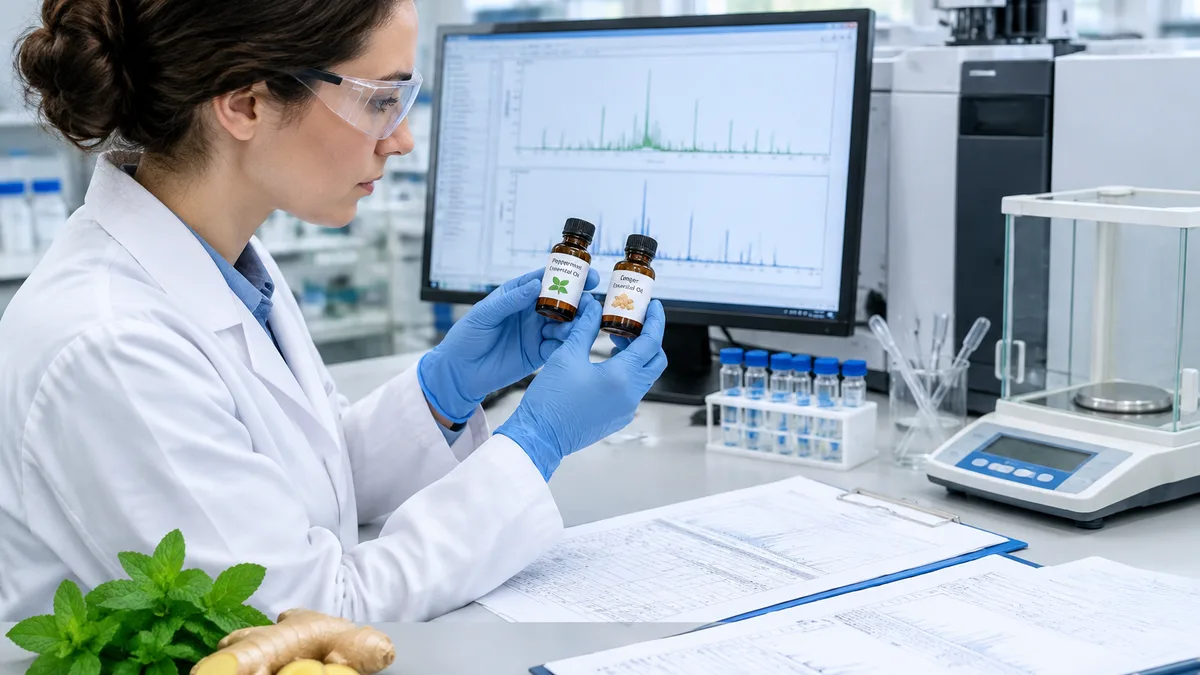
Fresure prepared trial blends at the three requested ratios and subjected each to sensory evaluation and functional testing. Samples were provided with full gas chromatography-mass spectrometry reports showing the quantified constituent profile of each oil and the calculated composition of the blended product. The pharmaceutical company's sensory panel evaluated aroma intensity, pungency, cooling sensation, and aftertaste, while in vitro assays measured the oils' effects on markers relevant to digestive function. The 50:50 blend emerged as the preferred candidate, balancing menthol's cooling impact with ginger's warming spice notes and delivering the desired functional activity without excessive pungency that might limit consumer acceptance.
With the formulation finalized, Fresure initiated stability testing under conditions specified by the pharmaceutical company's regulatory affairs team. Accelerated stability studies exposed the encapsulated blend to elevated temperature and humidity over a 12-week period, with sampling intervals at weeks 0, 4, 8, and 12. Gas chromatography tracked constituent degradation, particularly the susceptibility of gingerol to convert to shogaol and the potential for menthol oxidation. Microbiological testing confirmed that the blend remained free of aerobic bacteria, yeast, mold, and coliform contamination throughout the study period, validating the antimicrobial properties inherent in both essential oils and supporting a conservative shelf-life claim. Fresure provided the complete stability dataset, including chromatograms, microbial plate counts, and an analytical summary report that the pharmaceutical company could reference in regulatory filings and customer inquiries.
The Process: From Initial Consultation to Scale-Up and Private Label Packaging
The project moved through four distinct phases, each managed through direct coordination between Fresure's technical team and the pharmaceutical company's project lead. Phase one, initial consultation and specification development, took place over three weeks and involved detailed discussions of the product concept, target market, regulatory requirements, and desired packaging format. The pharmaceutical company intended to deliver the blend in vegetarian softgel capsules, which required the oil to remain liquid at room temperature and exhibit low viscosity for efficient encapsulation. Fresure confirmed that the peppermint-ginger blend met these physical requirements and that both oils were compatible with typical softgel shell materials without causing plasticization or leakage.
Phase two focused on sample creation and iterative refinement. Fresure produced small-batch samples of the three candidate blend ratios, each accompanied by a certificate of analysis and a detailed specification sheet. The pharmaceutical company conducted internal sensory testing with a trained panel and shared feedback on aroma balance and pungency intensity. Based on this input, Fresure adjusted the ginger oil sourcing to select a lot with slightly lower shogaol content, reducing the sharp heat note that had been flagged in the initial 60:40 peppermint-to-ginger trial. A second round of samples incorporating the adjusted ginger lot confirmed that the 50:50 blend now met all sensory and functional criteria. This iterative process, completed within five weeks, demonstrated the advantage of working with a supplier whose in-house blending and analytical capabilities allowed rapid formulation adjustments without the delays inherent in multi-party supply chains.
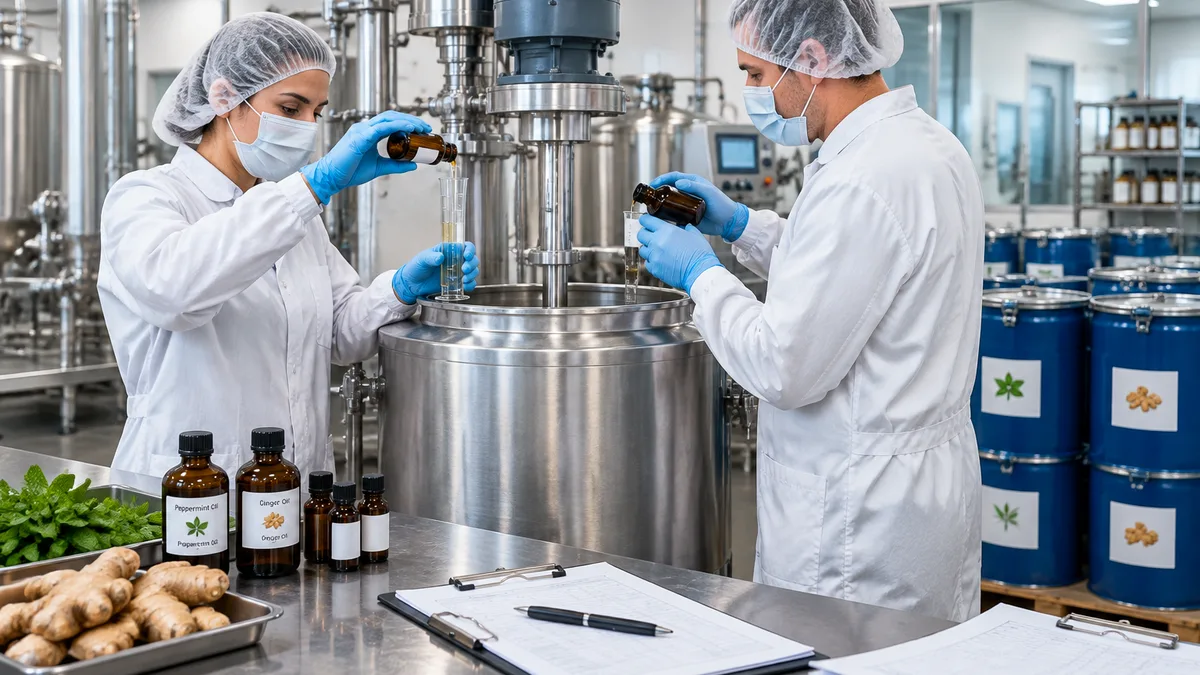
Phase three addressed scale-up and production validation. Fresure produced a pilot batch of 200 kilograms using the finalized formulation and the same distillation and blending equipment that would be used for full-scale production. The pilot batch underwent the same analytical testing as the development samples, with results compared against the agreed specification to verify that scale-up had not introduced compositional drift. The pharmaceutical company received samples from the pilot batch and conducted encapsulation trials at their contract manufacturer, confirming that the blend's viscosity, fill weight accuracy, and capsule seal integrity met production requirements. Fresure's quality assurance team provided batch production records, including raw material traceability, equipment cleaning logs, and environmental monitoring data, documents that satisfied the pharmaceutical company's supplier audit requirements and supported their internal quality management system.
Phase four delivered private-label packaging and certification documentation. The pharmaceutical company required the finished blend to be packaged in 25-kilogram stainless steel drums with tamper-evident seals and inert nitrogen headspace to prevent oxidation during storage and transport. Fresure coordinated drum sourcing, filling, labeling, and sealing, then arranged logistics through a freight forwarder experienced in handling temperature-sensitive botanical materials. Each drum was labeled with the custom product name, batch number, production date, specification reference, and a QR code linking to the digital certificate of analysis. Fresure provided the pharmaceutical company with certified copies of the Kosher and Halal certificates covering the production facility and the specific blend, along with letters of guarantee confirming that the blend met the requirements of both certification programs and that no cross-contact with non-compliant materials had occurred during production.
The Results: On-Time Launch and Validated Consumer Response
The pharmaceutical company launched the digestive wellness supplement on schedule, eight months after the initial supplier search began and four months after engaging Fresure. The product entered distribution through natural health retailers and e-commerce channels in the United States and Canada, supported by marketing claims grounded in the stability data and constituent profiles Fresure had provided. The company's regulatory team successfully navigated dietary supplement registration requirements in both countries, citing the GC-MS reports and Kosher certification as supporting documentation in their submissions.
Consumer response during the first six months exceeded internal projections. Pilot testing conducted prior to full launch involved a panel of 200 consumers who used the product daily for four weeks and completed structured feedback surveys at weeks 1, 2, and 4. Survey data indicated that 95% of participants reported the product's taste and aroma as acceptable or better, with particular appreciation for the balanced cooling and warming sensations that distinguished the blend from single-oil competitors. Participants noted that the softgel format eliminated the strong aftertaste often associated with liquid essential oil drops, and the dosing convenience supported consistent daily use. Functional feedback was similarly positive, with participants reporting subjective improvements in digestive comfort and reduced bloating, outcomes consistent with the known pharmacological effects of menthol and gingerol on gastrointestinal motility and inflammation.
The pharmaceutical company's quality assurance team conducted ongoing monitoring of retained samples from each production lot, storing capsules under ambient and accelerated conditions to track long-term stability. Data collected through the first year confirmed that the blend remained within specification for all key constituents, with no significant degradation of menthol or gingerol and no microbial growth. This real-world stability performance validated the accelerated study data Fresure had provided during development and supported the company's decision to set a 24-month shelf life for the product, a competitive advantage in a category where many botanical supplements carry 12- to 18-month expiration dates due to ingredient instability.
From a supply chain perspective, the pharmaceutical company benefited from Fresure's vertically integrated model. Because Fresure controlled both peppermint and ginger oil production, the company experienced no supply interruptions during the first year, even as global shipping delays affected other ingredient categories. Batch-to-batch consistency remained tight, with constituent profiles across five production lots varying by less than 1.5 percentage points, a level of control that would have been difficult to achieve with a multi-supplier sourcing strategy. The predictable quality allowed the pharmaceutical company's contract manufacturer to maintain stable encapsulation parameters and eliminated the need for frequent formulation adjustments or process requalification.
A Blueprint for Pharmaceutical Buyers: Leveraging Supplier R&D and Certification
References
U.S. Food and Drug Administration. Guidance Documents & Regulatory Information by Topic (Food and Dietary Supplements) | FDA.
U.S. Food and Drug Administration. Facts About the Current Good Manufacturing Practice ....
U.S. Food and Drug Administration. FDA 101: Dietary Supplements.
Frequently Asked Questions
Practical answers related to this article.
What was the product concept for the nutraceutical line?
A digestive wellness supplement combining peppermint and ginger essential oils, targeting consumers seeking natural digestive support without pharmaceutical intervention.
Why did the pharmaceutical company need a custom essential oil blend rather than off-the-shelf oils?
Because the formulation required precise ratios of active constituents—menthol and menthone in peppermint, gingerol and shogaol in ginger—to achieve the desired efficacy and taste balance, and off-the-shelf oils lacked the required consistency and constituent-level composition data.
What key certifications did the supplier need to have?
The supplier needed to have Kosher and Halal certification for its production facilities to open distribution channels in markets requiring religious dietary verification.
What was the preferred blend ratio that emerged from sensory testing?
The 50:50 peppermint-to-ginger blend emerged as the preferred candidate, balancing menthol's cooling impact with ginger's warming spice notes.
How did Fresure conduct stability testing for the blend?
Fresure conducted accelerated stability studies by exposing the encapsulated blend to elevated temperature and humidity over a 12-week period, with sampling at weeks 0, 4, 8, and 12, tracking constituent degradation via gas chromatography and confirming microbiological cleanliness.
How was the finished blend packaged for distribution?
The finished blend was packaged in 25-kilogram stainless steel drums with tamper-evident seals and inert nitrogen headspace to prevent oxidation during storage and transport.